Wednesday, April 24, 2013

All about the People - Villages in the Shan Mountains

  With relief, we left the frying pan that is the plain of Bagan for the cooler climates of Pyin Oo Lwin. The town was used by the British as its summer capital, thanks to its higher elevation. It did not disappoint us either, when we finally got cold at night. The center is rather small and standard, but it's the old colonial houses, their shaded plots of land and dainty horse-led carriages that reminded us of the old charm. We side tripped to a nearby Dat Taw Gyaik waterfall. A 45 minute hike down revealed not some drizzle of water but a sight as few we've seen: huge columns of water dropped from a greenery of the jungle into pools of aqua water. The freezing water allowed for a swim that lasted all of a minute, but the beauty of the waterfall was jaw-droppingly breathtaking, even more so since it was unexpected. What a treat. We ended the day with some deliciously sweet strawberries, bought from a roadside stall.

Eating local style for less than $1


P buying a longyi

Pretty, no?


  We were informed, repeatedly, that train travel in Burma is an interesting experience, so, just for the sake of first-hand knowledge, we forked over the government fee, ahem.. train ticket money for ordinary class, and set off for a ride from Pyin Oo Lwin to Kyaukme. And boy, were we in for a spin. A helpful local parked us and our baggage on some wooden benches, and hurried to help some women, seemingly headed to a market, with some of their “luggage”, i.e. huge baskets of strawberries, flowers, wicker goodies... all that was missing were some chickens running around the aisle. As wheels started turning with the usual hissing sounds, some locals temporarily closed the windows on one side of their train. Puzzled, we quickly found out why, as streams of water from a hose sprayed into the wagon. Happy New Year! - here celebrated with a water festival. At least it felt nice on a hot day. As the train picked up speed, the wagons, each with a life of its own and like some insane carousel from hell, started jumping up, down and sideways, as if competing which goes further. For five hours, at maybe 25 mph, probably double the travel time when compared to a bus, as some tracts were unstable and the driver had to proceed cautiously. Proved helpful, especially when we went over a deep gorge. But the atmosphere inside was cheerful, no English but smiles all around. The whole wagonful of people was gesticulating and helping us when we almost got off at the wrong station. It's experiences like this – this connection with the locals – that make backpacking so worthwhile.


  While most people head to Hsipaw for trekking, P dredged up some info on Kyaukme and its, as yet, mostly undiscovered charms. The town has only one guest house licensed to house foreigners, so choosing a hotel was easy (if not entirely pleasant). Thura, our guide for the next few days (as we'd be venturing into some mountainous areas which were restricted just a few months ago) picked us up from the station. After negotiating our arrangements, we set off the next morning on scooters to start our communion with nature. Since it is the dry season, much of the landscape carries a brownish tinge, vegetation looks starved for water and the potted asphalt (sometimes) gives off a visibly undulating wave of heat. Winding roads coated us in fine dust, but the higher we climbed, the prettier it became. In places, flames of fire peeked from behind hills, where locals set fire in accordance with the astrological signs to clear out the dead brush. A bit unnerving, especially when you find your hiking path blocked off.


  We spent the first night with a family in a Palaung tribe village, in a traditional wooden house. A quick walk through the village earned us stares, curiosity and cries of “anglec, anglec!” (English English! Oh man, the legacy carries on). A man died shortly before our arrival and his family invited us to the funereal celebrations. Interestingly, everyone was laughing. Thura explained that they believe that when a person dies, especially an older person, he or she continues, through the cycle of rebirth, on to the next life, so there's no need for sorrow. Half the village gathered for the celebration, to send off the man in style. Food and rice wine galore.


Our "home" for first night


Charity, a beautiful concept in Buddhism


Palaung women


  The next day, Thura improvised the hike after our host family suggested a visit to its tea plantation – tea picking is the main occupation of the area. I always bitched at my commute to work in Chicago, but I have nothing on these people as they run up and down mountain slopes to reach the location, with us huffing and puffing (ok, that's me, P being better at this) to keep up. Now there's a hike. We then spent a lazy morning, observing the different lifestyle of these hard-working people and playing with the kids. The father showed us part of the way to our next village, since we didn't want to backtrack. And...we got lost. Hours of marching got us to a Shan village, but not the one we intended. With sunset around the corner, Thura found a family willing to host us for the night. We slept... in a store, but the woman owner welcomed us as if we were long lost family. A quick outside shower (more like a pipe running from a water tank – I had to shower covered in a borrowed longyi!) restored our energy. We spent the evening entertaining the horde of kids (you'd be surprised how taking a photo and showing it to them can cause peals of embarrassed but delighted laughter) and using Thura as a translator and source of much valuable information. The woman thus told us that she adopted two of the boys after their parents died. The smaller one, not even two years old, constantly followed her with an unnaturally sad face. We called him the little old man. He broke our hearts – we've never seen such a little child so detached. But then we haven't seen much of the children of the developing world. We did what we could to make him laugh in the short time we were there. I know he'll be on our minds for a while.

Tea factory


Drying of green tea


Preparing tanaka, used on the face to prevent sunburn


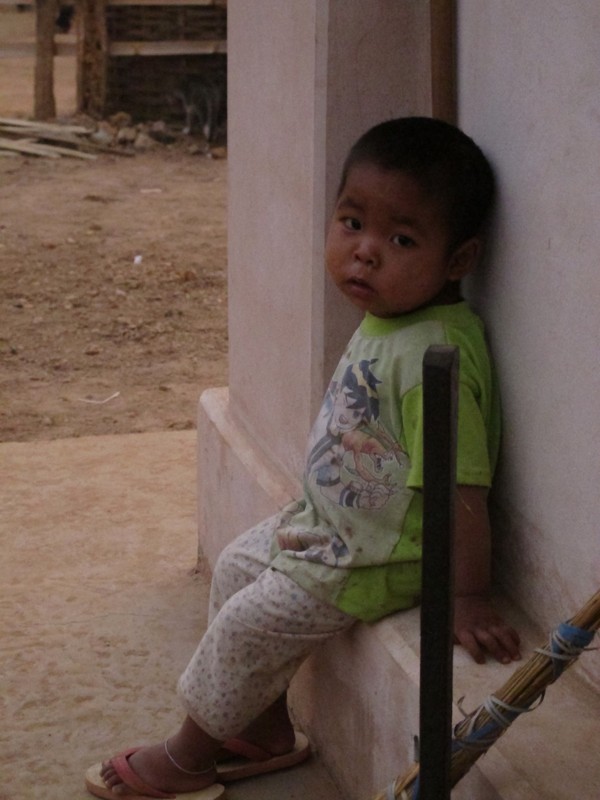
Precious little old man


Agh, leeches

Thura modelling :)

  We finished our hike back to the scooters, grabbed our gear and left for town. In the evening, Thura invited us out for beer, and we spent it trying to communicate with his Chinese friend. What a character this one is, and what a life story he has. Ex-soldier, in trouble with the Communist Party, he left for a better life in Myanmar. Now he's a history teacher to the Chinese community of Kyaukme and his appetite for knowledge (he was asking us about Katyn!) is insatiable.

  Since the Water Festival was looming ahead, which meant interrupted transport service, we moved on early next morning to Inle Lake in anticipation of the Burmese holiday.

Practical Information:
Grace Hotel 1 in Pyin Oo Lwin- $25 for huge, recently upgraded fan room with en suite bathroom, free breakfast and a leafy garden
Scooter rental for half day – 5,000 kyat
Train tickets for ordinary class to Kyaukme - $2 each
A Yone Oo Guest House in Kyaukme - $18 for double room with shared bathrooms; room was fine, if on the smaller side, pretty noisy and rudish service, but what do you expected from the only foreigner licensed hotel in town
Guided 3 day tour with scooter into mountain villages – 25,000 kyat per person per day, with all costs included; we liked Thura and his guiding methods, so for contact info check out http://thuratrips.page.tl/


Tuesday, April 23, 2013

Temple here, temple there - 4,000 temples everywhere


  With some serious temple experience under our belts, we were curious what impressions, if any, would be evoked by Bagan. Located in the center of the dry zone, Bagan consists of ruins of over 4,000 Buddhist temples, some constructed as early as the 11th century. Over the years, many have been neglected, destroyed or questionably restored, and thus their archaeological value has been somewhat compromised. Many frescoes, paintings, murals and carvings can now only be completed in the imagination. It is no Angkor Wat as far as quality is concerned, but the sheer volume of the structures, the wide swath of land that they cover and the sweeping views at sunset easily give the former a run for its money. Top it off with limited tourist congestion and leisurely bicycle rides at your own pace, and you quickly get a place appreciated for its, as yet, under-appreciated charm. If only it wasn't so hot...


Mount Popa

Nat, or spirit, representations


Practical Information
View Point Inn - $18 for double AC room in a somewhat shabby but still strangely pleasant hotel with shared but clean bathrooms, comfy beds, friendly staff and a free breakfast
Bagan entrance fee - $5, except we unintentionally circumnavigated it, finding out only on the last day that one was required, so I guess it's not always enforced
Bus to Mandalay – 7,500 kyat per person
Minibus to Pyin Oo Lwin - 6,000 kyat pp
Most restaurants are on Restaurant Row in Nyaung U (good options for accommodation), with the beer garden Shwe Ya Su providing some of the cheapest and tastiest food.
Internet is dial-up slow, sporadic and frequently affected by power outages.

Monday, April 22, 2013

The Burmese Days - Yangon


  When first planning this trip, we went back and forth on the idea of visiting Myanmar, formerly known as Burma. We read about many different impressions. On the one hand, the long established military junta in power (seemingly replaced by a civilian government in the tainted elections of 2010) has a long record of corruption and human rights violations that has left its people impoverished, repressed and isolated. For decades, the country has been under a travel boycott (not to mention Western sanctions), called for by an opposition party, the NLD (led by the now symbolic figure of Aung San Suu Kyi, under house arrest for non-consecutive 17 years) in defiance of the ongoing abuses. It lifted the boycott only in 2010, as a way to infuse funds into the struggling economy and thus help its people on the most basic level. Granted, many fees still fill the pockets of the few rich and in power, but conscientious and (we heard) independent travel can aid on the grassroots level. Unfortunately, the sub-par infrastructure and standards cannot fully support the influx of tourists, which means the prices on even basic accommodation, for example, have skyrocketed. With that said, Myanmar is still the unexplored land, attracting only a minuscule portion of tourists that visit, say, neighboring Thailand. In a way, this leaves the country and its warm, open people mostly untainted by the competition and lures of mass tourism and cut-throat development. Off the beaten path (or at least off the backpackers' Banana Pancake trail), it's a refreshing wonder to experience. Its reminder of the olden days is its greatest charm.

  So we heard, and finally decided to see for ourselves. We reached Bangkok, all of our attention bent to the task of obtaining our visas. We tried before, but lacked the time and the air tickets to complete the process. Again, we got up at 5 AM to reserve our spots in the queue, only to find a sign proclaiming the day a national holiday. The embassy was closed, of course. Super, especially since we had next-day departure tickets. Little we could do; we gritted our teeth and bought new ones for the day after. Hoping third time is a charm, we took our spots in the line at 7 AM, making sure our paperwork was immaculate (so: visa app from a shop around the corner, 2 passport photos, copy of flight reservations, copy of passports, passports themselves, and 1,260 bhat fee each, all needed for the express same day visas). About 3 hours of wait got us to the counter where an expedient clerk accepted the package. We returned at 3 PM to another line, this one hot and sweaty, after spending the day with a fellow Burma-bound Aussie at the MBK mall, relishing the air-con and the cheap, tasty eats. After another hour of wait and dreams of a long, cold shower, we left relieved, our glossy new visas and passports in hand. Fist bump.

  First stop: Yangon – former and still unofficial capital of Myanmar. Reminds me of some Polish cities back in the 80's, but more tarnished and cluttered. 


 Ongoing construction ensures most sidewalks (or broken slabs of concrete) are uneven, wobble and have holes you can hide your whole leg in. Unintentionally, of course. I recommend a flashlight for any night ventures (helps in the frequent power outages, too). 


  Vehicles speed by without any regard for pedestrians, so its their responsibility not to get hit. There are no motorcycles at least, as they were prohibited in the city after some high-ranking official got hit by one. The most popular method of dining is on little kiddie-sized plastic chairs, placed right on the “sidewalks”.


Man in longhyi

  Everyone and their mama is out on the streets, eating, socializing, watching soccer games on communal TVs, bickering good-naturedly. So interesting to sit back and watch, although our foreignness frequently engaged people's curiosity and invited the standard questions. Basic English was common enough. We heard disparaging opinions on the Burmese cuisine, seemingly a mix of Thai and Indian influences, but not as flavorful and more oily. Funnily, to get someone's attention, you make kissy noises. It felt a bit awkward at first, but the reaction was instantaneous. Tea-houses and cafes are rampant, but the prices are unexpectedly high. It was also hot. So hot, in fact, that steady rivulets of sweat left salty stains on all our clothes.

  We tripped and stumbled all over the central part of the city, admiring some outstanding colonial architecture. Most of it is neglected, although some renovations seem to be under way. 


  But the crown jewel of the city (literally!) is the Shwedagon Paya (pagoda). Supposedly originally constructed 2,500 years ago, at the time of Buddha, it has been gilded over the centuries with 90 tons of gold, thousands of precious stones, and a 70 karat diamond was affixed to the top of the highest spire. The pagoda looked beautiful at sunset, but it was the night lighting that truly showed off its grandeur. We learned that many Buddhist believers from the country hope to visit the pagoda at least once in their lifetime. 


  After a few days, the chaotic city drove us to seek a more peaceful location. We took a surprisingly efficient bus to Bagan for a peek at the immense ancient temples.

Practical Information, since there are such radical fluctuations in prices:
$1 = 876 kyat (at airport, despite what Lonely Planet says, one of the best exchange rates for now; both currencies are accepted interchangeably, though dollars usually cover higher expenses; all dollar bills have to be in pristine condition)
Express visa = 1,260 Thai bhat (about $40)
taxi from airport to city center = 8,000 kyat
Ocean Pearl hotel = $30 for a clean double room, with AC, free wifi and free breakfast
Shwedagon Paya = $5 or 5,000 kyat, taxi to paya = 2,000 kyat
taxi to bus station = 6,000 kyat
bus to Bagan = 15,000 kyat
bottle of water = 200 to 400 kyat

Good eats on 19th St